

Purchasing a dream vehicle is a personal matter; therefore, when consumers enter a showroom, their choice could depend largely on cost, design and features, among others. However, it must be noted that the government policies and regulations have a greater impact on the Indian automotive industry than what consumers think. It is through such policies that the production and availability of new cars in India in showrooms are decided by the government.
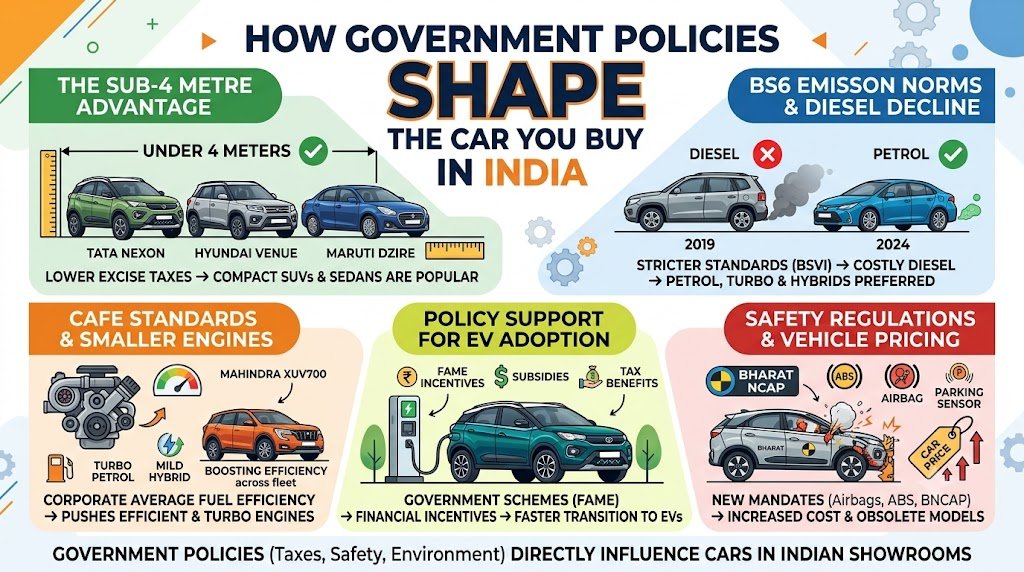
Sub-4-Metre Cars Became Popular
It is one of the best examples of how government policies can affect the production and popularity of cars in the country. The sub-4-metre cars were taxed according to the engine capacity, which provided an economic advantage to produce cars under such specifications. Consequently, manufacturers started producing compact sedans and subcompact SUVs like the Maruti Suzuki Dzire, Hyundai Venue and Tata Nexon.
What looks like consumer preference for small SUVs is also due to the government policy.
Norms for BS6 Emissions Have Lessened the Options for Diesels
Another way that regulations have affected the Indian car market is that diesel cars were very popular before. But the new BS6 emission norms brought about in 2020 have made the production of small diesel engines more costly and complicated.
Due to this reason, many companies discontinued producing cheap diesel cars. More and more people started buying petrol cars, turbo-petrol cars, and hybrids. Though changing consumer preferences were one of the factors, the regulations also helped in bringing about this change.
CAFE Standards Promoted Smaller Engines
Corporate Average Fuel Efficiency standards have also impacted modern vehicle design in a similar manner. Such standards mandate the manufacturers to maintain efficiency standards throughout the entire range of vehicles manufactured by them.
This has led the manufacturers to focus on designing smaller and more efficient engines. Turbocharged petrol engines, mild hybrids, start-stop mechanisms and regenerative braking have become commonplace because of this. Large SUVs too are being equipped with small turbocharged engines in order to boost efficiency.
Safety Regulations Have Impacted Vehicle Pricing
Safety standards have made modern vehicles much safer. Devices like airbags, anti-lock brakes, rear parking sensors and crashworthiness standards have become significant, whereas the new Bharat NCAP standards have brought greater emphasis on crash testing.
The issue here is that of cost. Enhancing safety means enhancing manufacturing and development costs. Some old models in the economy segment could not be upgraded economically and hence became obsolete, whereas some affordable vehicles became pricier.
EV Popularity Has Been Helped by Policy Support Too
The government has also aided in the popularity of EVs through incentive schemes like FAME. With the help of tax and registration policies in different areas, the financial aspect of owning an EV has been improved. The transition to electric mobility in India would have been slower without the help of government policies. In the end, the consumer has a lot of freedom in choosing his or her car, but the choice is made in an environment created by government policies. The cars that are available for purchase in the showrooms are not only based on the requirements of the consumers but also because of tax, environmental, safety, and incentive policies.